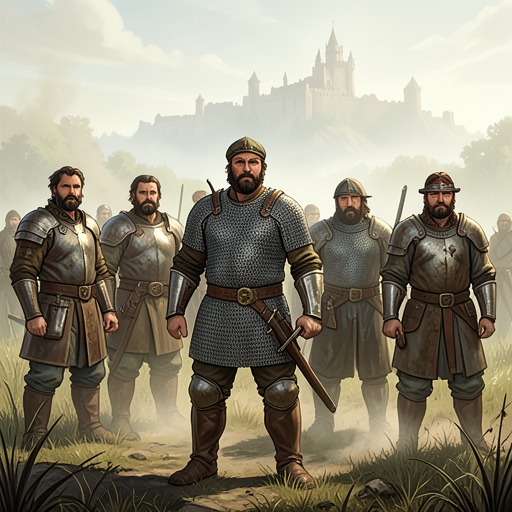
Siege of Ascalon
Foucault's PendulumThe Siege of Ascalon is narrated as a failed assault in which the attackers’ apparent breakthrough becomes a trap. The breach in the city wall invites a charge, but the Templars’ decision to send their own men through first isolates them inside the city and ends in the slaughter of forty Templars, including their grand master.
The Assault and the Breach
In the account, the king of France, the Holy Roman emperor, King Baudouin HI of Jerusalem, and the grand masters of the Templars and the Hospitalers set out together to besiege Ascalon. Their force included the king’s court, the patriarch, priests carrying crosses and banners, and archbishops from Tyre, Nazareth, and Caesarea. The procession is described as almost festive, with standards flying, tents around the city, and drums beating.
That display of confidence met a city prepared for attack. Ascalon had one hundred and fifty towers, and its inhabitants had made slits in the walls of their houses, turning each home into a fortress within the larger fortress. The attackers nevertheless built wheeled battering rams and wooden towers to approach the walls, while catapults hurled rocks from a distance. The defenders tried to set fire to the siege towers, but the wind drove the flames back onto their own walls. A section collapsed, giving the attackers the breach they had been waiting for.
The Templars’ Reversal
The grand master ordered a cordon so that only Templars could enter the city. The account leaves his motive uncertain: the restriction might have been intended to reserve the booty for his order, or it might have reflected fear of a trap and a wish to send his own fighters in first. Whatever the reason, the decision shaped the disaster that followed.
Forty Templars ran through the city and reached the wall on the far side, where they stopped in a cloud of dust and apparently realized that they had advanced into an untenable position. They turned back, but the return route took them past the Saracens, who pelted them with rocks and darts. All forty were killed, the grand master among them. The defenders then closed the breach, hung the corpses from the walls, and jeered at the Christian force with obscene gestures and laughter. The opening that had seemed to promise victory became the means by which the Templars were cut off and destroyed.
Retelling and Irony
The siege is presented within a conversation in which a listener asks to hear the story of Ascalon. Its telling punctures the grandeur of the assembled rulers and churchmen: the campaign begins like a great public spectacle, yet ends with a small force blundering through the city and being annihilated. The narrator’s wry judgment that the grand master would not make a suitable head of a military academy sharpens the contrast between the Templars’ reputation as capable fighters and their failure to anticipate the consequences of their own entry plan.
The account does not offer a clean explanation for the grand master’s order; it sets cynical and charitable interpretations beside one another, then lets the outcome expose the risk in either case. The final exchange continues the scene’s bitter irony: Belbo calls the Moor cruel, and Diotallevi answers, “Like children.”